
Five hook formulas that stop the scroll
The first line decides whether anyone reads the rest. Here are five reusable hook formulas, with examples and when to use each one.
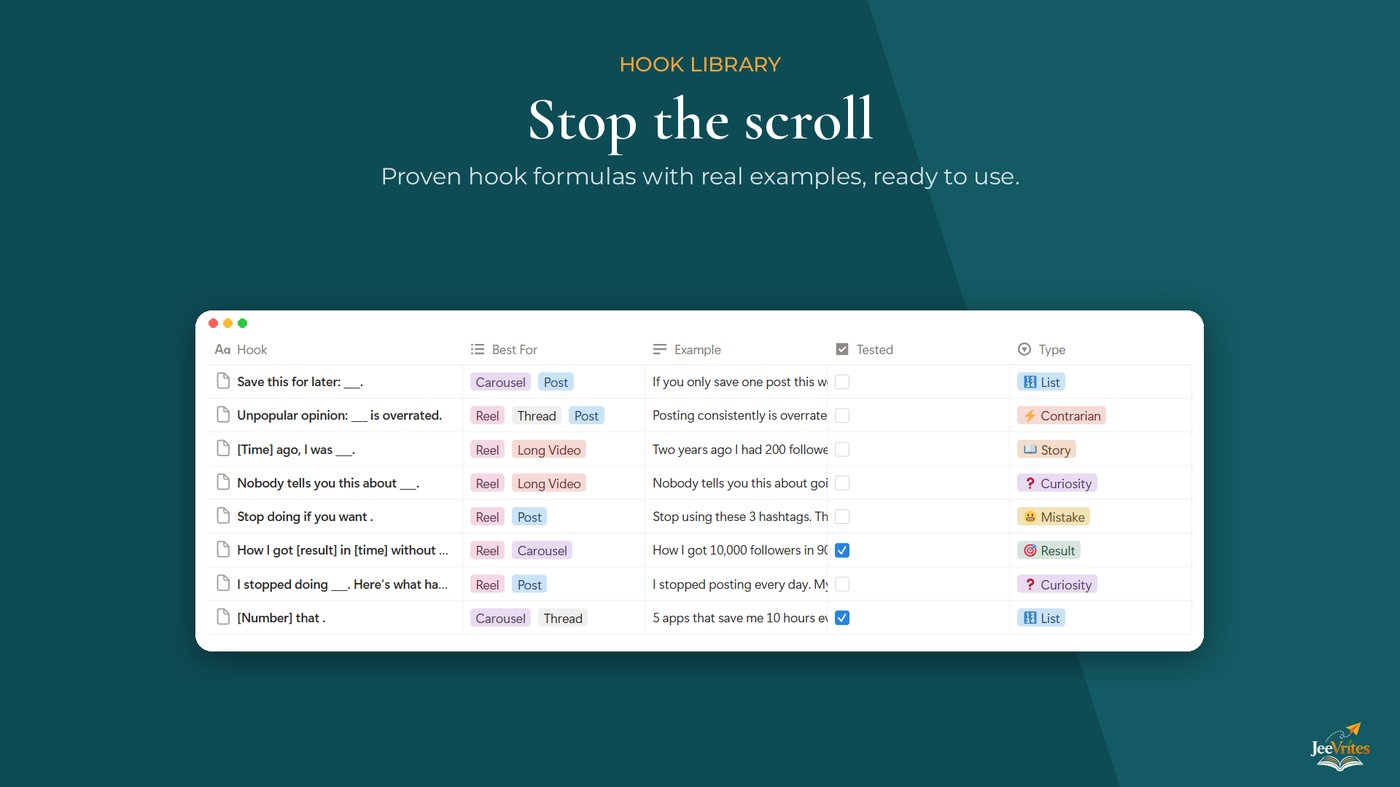
People decide whether to keep watching or reading in about a second. That second belongs to your hook, the first line of a caption or the first words of a video. A good post with a weak hook rarely gets the audience it deserves.
The good news is that strong hooks follow patterns. You don’t need to be clever every time. You need a few formulas you can adapt to any topic.
1. The surprising result
Formula: I stopped doing ___. Here’s what happened.
Example: “I stopped posting every day. My views doubled.”
This works because it breaks an expectation. The reader assumed one thing, and you’re about to show them the opposite. Use it when you have a real before-and-after to share.
2. The hidden truth
Formula: Nobody tells you this about ___.
Example: “Nobody tells you this about going full-time.”
People love the feeling of being let in on something. Use it for lessons you learned the hard way, the kind a beginner can’t find in the usual advice.
3. The respectful disagreement
Formula: Unpopular opinion: ___ is overrated.
Example: “Unpopular opinion: posting consistently is overrated.”
A clear opinion invites comments, both agreeing and disagreeing. Only use this when you genuinely hold the view and can explain why in the rest of the post. A hook that makes a promise the content can’t keep costs you trust.
4. The specific promise
Formula: How I got [result] in [time] without [pain].
Example: “How I planned a month of content in one afternoon, without burning out.”
Specific numbers and time frames feel believable in a way vague promises don’t. Use it for tutorials and case studies.
5. The bookmark
Formula: Save this for later: ___.
Example: “Save this for your next shoot: three lighting fixes that cost nothing.”
This one tells people what to do with the post before they’ve read it. Saves are one of the strongest signals a post can get, so it suits checklists, templates and step-by-step guides.
How to use them
Keep a running list of hooks you like, tagged by type. Before you write a post, pick the hook first. It forces you to decide what the post is really promising, and the rest usually writes itself.
After a few weeks, check which hooks brought the most saves and shares, and use those types more often.
Creator Content Planner includes a ready-made hook library with these formulas and more, alongside a production board, calendar and performance tracker.